
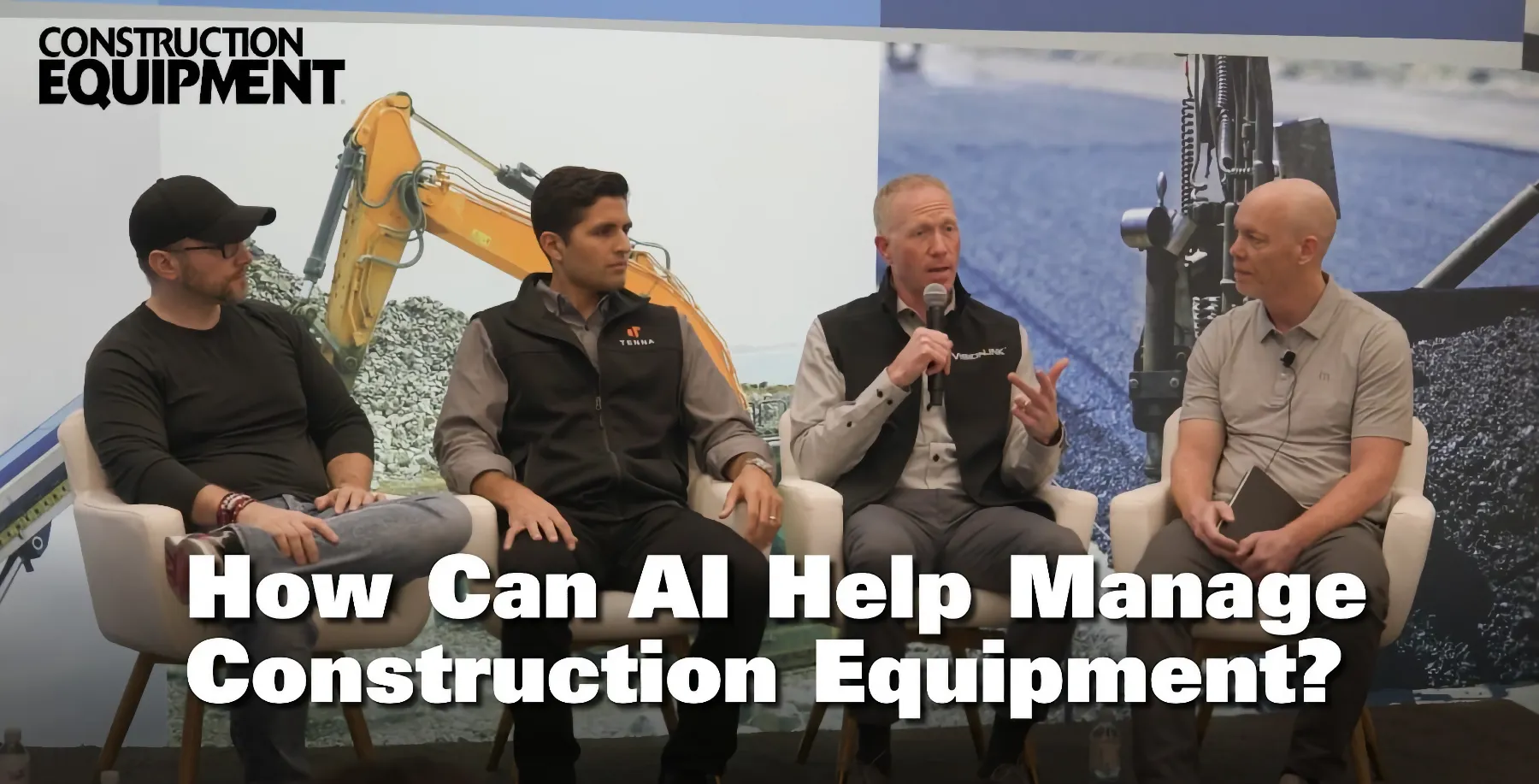
This session from ConExpo 2026 brings together three industry experts to break down how AI is actually being used in equipment management today.

Transcript of the video:
This is Keith Gribbons with Construction Equipment coming to you from ConExpo 2026. We are in the Endeavor booth. Today we’re going to have another panel on AI in construction, specifically AI and fleet management. Brought together three amazing panelists here today to talk about AI and fleet management and construction equipment. AI definitely two words that are buzzing around right now. It’s everywhere. where it’s in our phones and our TVs and our cars and now in our construction equipments. A bit of a hype cycle around it, but there is a lot of practicality coming out of this technology that I think a lot of people don’t realize. And we brought these three panelists together to help us understand AI and how we can apply it in our fleet management and in our machines. I want to introduce these three. I want to thank them all for coming out to help us today. We’ll start with Craig. Craig Gramlich, owner of Lonewolf Consulting. Craig, maybe you can tell us about yourself and your business.
Sure. Thanks, Keith. Craig Gramlich, owner of Lonewolf Consulting and I also write articles for Construction Equipment Magazine. I build equipment leaders is what our company does. They are companies who are committed to best-in-class performance of their assets. We end up finding waste, we end up finding overspending and we boost their ROI through work with us, through a mix of assessments, training and coaching. The unique thing about me that I bring to the panel is I have a distinct background in three specific areas which is equipment, accounting and operations. I’ve worked in all three. I’ve held positions from entry level all the way up to seuite and senior leader. So I’m looking to ground the conversation as much as I can.
Awesome. That’s what we want. Craig, one quick question. You only get one or two sentences to answer. If there was one headache that you could solve with AI in fleet management, what would it be?
Data processing for decisions.
Okay, awesome. Next, I would like to introduce Jose Quueva from Tenna. Jose, maybe you can tell us a little bit about yourself and what Tenna does.
Yeah, absolutely. Good morning. Thank you for having us. It’s it’s a pleasure to be here. My name is Jose Quueva, co-founder at Tenna, also chief product officer. I oversee all of our digital software and hardware products. And I come from construction. I’m actually a civil engineer myself. I worked in heavy civil residential and commercial construction internationally and abroad before jumping over into this tech journey of Tenna to build a mixetle asset management platform that helps contractors with all of our operations from small tool management all the way up to large equipment utilization, safety, resource management.
Awesome. One quick question, one or two sentence answer. What do you think is the biggest barrier right now for fleet managers or equipment operators when it comes to AI and document?
I think it’s making sure that the AI solution is practical and that it it fits into their workflows.
Perfect. Our third panelist is with Caterpillar. I’m sure you’ve heard that brand before. Brent Stefen. Brent, maybe tell us a little bit about yourself, what you do.
Sure. My name is Brent Stefen. I work at Caterpillar. I’m vice president of digital product management in cat digital. My team has accountability for the majority of our customer and dealerf facing solutions things ranging from cat.com to vision link our full fleet equip management and productivity platform to our e-commerce solutions and condition monitoring. I always say that our team is doing our job the right way. We’re spending about half of our time in the dirt with our customers and dealers understanding their toughest challenges and then the other half the time working with our our incredible software engineering organization to go build these digital products and and help them drive customer value.
Awesome. Quick lightning round question here for you. One or two sentences. Where would you suggest someone started? They’re interested in AI fleet management purchasing.
It was a great week this week for Caterpillar at Con Expo where we launched the CAT AI assistant and we understand right our customers workflows are pretty complex and so we’ve embedded the CAT AI assistant directly into vision link for our full fleet equipment management into parts.cat.com cat.com for e-commerce into our service information systems. And so we really feel it’s a big step forward for Caterpillar in making our our customers workflows significantly easier. And so if I’m a contractor, I’d start with the CAT AI assistant. It’s ready today.
Awesome. Very cool tech. Let’s start off with some more in-depth questions. Go as long as you want. Elaborate, explain to our audience here. Let’s start with a baseline. AI, you know, people think autonomy right away. just machines operating by themselves. But AI comes in a lot of practical ways that are probably not realized. Maybe we get a baseline of what categories AI is showing up within fleet management. We’ll start with Jose.
Yeah, certainly happy to. When it comes to AI, from our vantage point, helping contractors manage their their mix fleet, you have to differentiate AI that runs on the edge on the actual machine or the tracker or the hardware that’s embedded into whatever you know physical equipment you’re dealing with and then AI that’s on the edge. Talking about on the cloud, AI on the edge, so that something that’s on the machine, the most practical application we see there is for safety reasons. So being able to have a dash cam or something of the sort, some sort of sensor that can understand the inputs around it and be able to make a determination of an unsafe event or something of the nature. So there you want AI to be running on the physical machine to inform the operator in real time so they can change whatever they’re doing and hopefully prevent accidents or worse. When it comes to AI on the cloud, there’s tons of applications across all sorts of business processes that contractors have to use. But what the real key there is having good data that you can work off of. Without good data really the AI outputs are not going to be useful. And being able to have enough of a data set that’s clean enough, understandable enough to give that end user the the final answer. Something from the tenant perspective that we’ve been focusing on is how do we give contractors faster answers on the simple questions that are really difficult to get data for. So something like which category of assets is the most underutilized because I’m trying to think about offloading some assets and right sizing my fleet. That’s a really simple question that would require lots of research and internal work to get answers but with AI on top of a good enough data set you can get a real clear answer immediately.
Awesome. Great information. Stefan Brent same question sort of what sort of silos categories would you put AI in when looking at it from CA perspective? You guys say well this this and this and this we have and this is how you
well I I think you know Jose’s response was very good about both AI in the cloud and AI at the edge when we look at at AI we don’t look at it as replacing people or you mentioned autonomy we’re jumping all the way to autonomy you know we recognize that our customers have many different roles within their organizations and we like to understand what are their workflows what are their challenges and how can we apply AI to it so a couple examples for our CAT AI assistant. We really want it to be practical and and very usable. So, for instance, if you have there’s a storm coming and you know, we can have our AI, you know, practically nudge you to let you know to top off the fuel so you’re not caught off guard. Cool. For our technicians, right, being able to to troubleshoot and diagnose takes a long time. And so, it’s like having hundreds of manuals kind of at at your fingertips. Condition monitoring is another really important area. And using our data science and AI, we’re really able to help, you know, predict potential failures and and have our AI inform customers of of where that could occur. And I think one other area is really around equipment selection. Not, you know, many of our newer customers don’t exactly know the right type of equipment or the right attachment for a job. And so our AI can help inform a customer if they’ve got an excavator and they’re digging a trench, help me understand the right bucket, the right the right teeth for this job to help make them, you know, much more efficient and productive. And so that’s the way that we see AI. It works best when it works across the different roles of our customers, organizations, and helps them with with, you know, just very much daily challenges that historically have taken a long time to solve.
Excellent. Thank you. Give this one to Craig. A little bit of a spin on the same question. Where would you like to see AI coming from a fleet manager perspective? Where do you think it would be super useful and integrated into the into those operations?
Thanks, Keith. Yeah, I was actually going to say the same is if the same question came across as I was going to mention, I’d try to ground it in this perspective of fleet manager is if I’m sitting behind my computer or if I’m on a remote site trying to look at the fleet, what do I want? What do I want for data? How do I make a decision with it? For me, it’s about embedding it into the systems and into the processes that I would use. So, I’m pulling in information from multiple different sources. It’s going to come off the machines, which are not necessarily one particular brand. It’s going to come out of a software system, hopefully coming out of an ERP with some cost information in it. It’s going to come out of an oil analysis, you know, oil analysis vendor and a few other data sources. And so the benefit I see for AI or where I would love to see it go in the future is pulling all that information sources in and being able to c like being able to query it, being able to say, “Okay, look at this machine. Here’s where it utilization health has been. Here’s where the oil the oil sampling analysis is showing me. I’m looking at this in terms of life I got from an undercarriage inspection to say I’ve got, you know, x amount of life left. Is this machine a candidate for repair replace? Do I push it out the door now or should I make an investment of undercarriage? And if I do, what really is the cost left that I have on it based on my internal rate?
Awesome. Awesome information. I want to build on that. Jose, move it from dashboards to decisions, you know, how do we take all this data and make it usable and and make the interface user friendly? Is that a big focus? Is that a big process? How is that being done? Now we’re taking all these telematics these fault codes and then we’re making it available the data available and also the decision making is certainly a part of that right agenda because every agent maybe you could talk a little bit about that.
Yeah absolutely when it comes to user interface and how do how do we see contractors and the personas in a construction site interact with an AI solution I think the simplest one is what has become most most popular in our consumer lives. That’s a good place to start when you think about adoption. So chat being one example, right? A textlike chatlike agent. That’s what we’re focusing on first to start. That really makes it really simple and really easy to understand and ask questions. The key there is some of the prompt engineering that has to go in where you may not know how to ask the right the right question. You may have an intuition of what you’re trying to get to. But helping the user along the way maybe by prompting them or telling them hey you should ask question in this way or reworking the prompt in the background is really important. But that experience of being able to ask questions, get good answers and then be able to dig into the source of that data within your own data set is where we have been focused on moving forward from that from an agent perspective being able to make decisions or make recommendations ahead of time. That I think is is what’s coming next and we’re we need to build build a little bit of trust within the personas in construction to understand that it’s not just annoying not another annoying notification on your phone suggesting you to do something. It’s really something that is rooted in deep data and rooted in the truth. And I think from that perspective the user interface should be slightly different. Definitely the notification and the prompt to action should be simple, elegant, something that catches their eye, but there has to be a lot of empirical data for that person to take that decision, that next step. And our folks we understand and and we know are folks that are tangible people, people that live in the actual physical world. So, being able to tell them the truth, whether that is a picture, a report, a graph, a sweet spot analysis, something that tells them, hey, this agent actually made a pretty good determination. Here’s the supporting evidence. I believe at that point we’re going to see a lot more adoption and folks going beyond just asking the questions to trusting the recommendation.
Great information. Brent, sort of along the same lines. What is CAT focusing on right now to to take all that data and help make decisions?
Yeah, I mentioned we’re talking a lot about AI and I think a lot of times it starts a little bit earlier than that with data science and condition monitoring analytics. Right. Your comment on alerts and dashboards and so much data and information. That’s one of the biggest challenges our customers share with us. Help me separate out the signal from the noise and that’s where we focus a lot of our analytics and data science on and then serving up only the certain pieces of equipment that really need review inside of vision link. And so kind of finding that needle in the haststack and being really clear within vision link here are the pieces of equipment in which a customer needs to act on. And then I think that’s where our genai comes into play, right? the the Gen AI and our CAT AI assistant makes it easier for a customer to understand what to do next, the next best action, walking them through how to do a repair, automatically requesting or scheduling service with a dealer or identifying the right parts needed for the repair and putting them directly into their shopping cart. So, we’re using data science, analytics, and AI together to really simplify the workflows and and reduce the need to traverse dashboards and look through all the data, right? We don’t want our customers to be, you know, data analytics experts. They’re really good at what they do. And if we can simplify their their day-to-day, then I think everybody wins.
That day is good. Craig, looking from the fleet manager perspective, what has your experience been with all that data coming in and using it and how do you use it to help make decisions? Is that do you see AI coming in helping that or is it a little does it seem like it’s a little off in the business?
I see AI actually helping with a lot of things right now, but we have to actually be mindful of what it can and can’t do. There’s limitations. Like if anybody’s played around with AI right now and given some impromptu queries, it can lead you in a different direction unintentionally. So when you’re you’re dealing with bigger decisions like your heavy equipment, you got to be very certain and very sure of the result you’re getting. Otherwise, you can make a bad recommendation. So there are limitations there. The one I would love to all obviously see with the AIS is AI is there’s a lot of hype around it right now. There’s a lot of words. You walk through the con expo show here, you see AI embedded, you know, AI supported, AI enhanced. You see AI is it’s a buzz word. It’s everywhere. The thing is it’s not all created equal. So every every manufacturer, every every OEM, every single user is going to have a slightly different spin on what AI means for them. But a lot of that, unfortunately, is going to be left to the end user in order to navigate through, sift through and figure out, okay, this is what I can use this AI tool to do. And there really isn’t, you know, one to govern all just yet. So where I would love to see some of that again is like more systems embedded. Is where’s my dashboard that I can trust? Is there one source that I can kind of query? And not to like throw anything else in, but there is like a little icon on somebody’s, you know, some people’s computers who uses Windows that they can open up and that launches into a few other streams. You know, if there is an AI tool that embeds into a lot of our other data streams, that would be the one to go for.
Awesome. Great information. Talk about maintenance. Obviously very important to manage your construction equipment. Telematics has always sort of had this promise that we’re going to predict failure port hazards. Do you see AI helping sort of predict the future in certain maintenance sort of situations? We’ll start with sorry.
Yeah, most definitely I see AI helping here. When I when I talk to our customers though, I think, you know, before you get into predictive maintenance, really nailing your planned maintenance and executing your PMs on time is, you know, the old adage is, you know, an ounce of prevention is worth more than a pound of cure. And so, starting with really good planned maintenance. And, that’s where Vision Link, I think, does really shine in terms of its ability to do planned maintenance for for CAT and non-cat. And when customers then have that in their workflows, then it allows us to focus on how can we get into our predictive repair predictions. This is an area that we spend a lot of time with going back the last several years. We have, you know, an incredible amount of data. We have 1.6 million connected assets feeding into our our platform. And we started repair predictions on really large components, thinking engines and drivetrains, and taking a look at utilization and usage severity and using that to help customers understand when is the right time to do a rebuild because too soon is obviously, as you know, costly and waiting too late is even worse. Then we moved into repair predictions. And these are some of those more nuanced and and nuisance repairs that are costly that our customers are saying, can you help us with solving this with all this data? One example we’ve gotten into is hydraulic fuel injector systems. And so we’re taking a look at telematics and fluid analysis and then repair history information kind of with all of our data science mapping that’s on a timeline and then predicting when these repairs are needed. When we do so we don’t just tell a customer you’re going to have a problem but rather we share with them here are the insights here are the steps you need to repair here are the parts needed to do so or here’s a dealer that can help you with it. So, it’s really about taking some of that accountability on ourselves so that our customers are more successful.
Awesome. It’s It’s cool with cats, too, because you have that telematics and that predictive maintenance sort of option, but you also have the parts and services integrated into a one-stop shop. Talking about those antenna, what have you seen? Have you seen some success stories with your customers talking about telematics and how it’s helped them improve their maintenance and how is AI going to work?
Yeah, absolutely. I think from a telematics perspective the maintenance system and being able to get a preventative maintenance schedule going on time is probably one of the biggest returns our investment our customers see from the get- go. We’ve had tremendous success stories reducing equipment costs and parts cost the cost of machines being down being down greatly and a lot of empirical examples of you know blown engines that no longer blow because they’re actually being taken care of at the right time. So having all of the preventive maintenance services in one place across all brands, makes, models down to the smallest asset that they need to maintain is a game changer for our customers cuz they can really see the true map of everything they need to take care of. Some of which they may take care of themselves, some of which they may actually give to their dealers. And from a tenant perspective, they can see what’s coming down the horizon. They can understand what parts are associated with it and then take their take the right actions either giving it to a dealer or dispatching. One of their mechanics. We’ve seen tremendous success when it comes to the amount of time it takes internal tech technicians to repair critical issues. The first step is giving it visibility and giving it a standard prioritization within the organization and approval flow across makes models, job sites, regions, business units. Right? So we’ve seen great success in getting mechanics once they understand there is a high priority item that they need to get to. How long does it take for them to repair that machine and get it back out? And we’ve seen that reduce from several weeks down to a few days for most customers. And that is tremendous when it comes to the output at the job center, which is what they really care about.
Yeah, definitely. Craig, think about predictive maintenance and maintenance in general. What inputs are the most important? You know, is it oil analysis, hours, fall codes? What do you think what inputs do you think would be perfect to stick into AI and then come out with solutions? The more the better.
Yeah. The more that honestly the more the better that you can put in AI. Absolutely. The thing I would love, you know, again to see and I I said it kind of yesterday during another kind of talk, but if we think of our mechanics and and the role they play, our mechanics are sent out to the field to repair a piece of equipment to troubleshoot it in order to get it back up and running. And AI can definitely support that and give you better access in order to do troubleshooting. our fleet managers and our supervisors and our staff back in the office can use AI to troubleshoot the system the same way that a mechanic can troubleshoot a piece of equipment. And when I say the system, I mean like the processes of how the workflow works through the company. When you have a breakdown or a red event, what was the what was the originator of it? Are you actually making improvement to your processes and your systems? And you can use AI now in order to do that is you can take a lot of the maintenance sections out of your OEM manuals and you can plug them into your AI tool as well as parts list things like that and you can go okay now if I was to optimize our maintenance plan and program right now from my current state based on what the OEMs are showing today what would that look like? It might be a bit scary when we start to see some of that volume of data kind of pouring out at you, but it it flips it flips things around for yourself as a fleet manager to be able to start looking at the data from more interval based instead of it just being a standard 500 hour,000 hour, 1500 hour kind of oil change cuz that’s where a lot of a lot of I would say companies are still stuck. They have a a PM level A and that’s we do this to drain oil. We do a PM level C and that’s where we get into hydraulics. But on your modern equipment, there is a whole lot more going on. When you crack open the back of that OEM manual and you see, you know, 5, 10, 15, 20 pages of things to change and check, it starts to really open up the door that you are both over and underervicing things. So, that is one area that AI can significantly help you with. There’s a lot of processing and analysis that goes into streamlining your PA program. Other things that can obviously go into it if you want to make decisions with it is your NDT testing and and things like that too. Obviously oil analysis you want but the more data the better.
Great answers. Let’s move beyond the management maybe to the operators we say. Where is AI showing up for the operating people in the cab? You know is it in their monitors? Is it in their cameras? and their control. Maybe talk about what kind of
Yeah, absolutely. When it comes to operators, we consider both drivers and operators, folks that get into machines that they operate, to be the key. There’s also folks that move machines around, support equipment. They may be in charge of fueling it, turning it on, actually, you know, operating it if you will, but not they’re not sitting inside of it. Typically, where we see AI and technology really help operators is first and foremost keeping those operators safe, right? When it comes to safety, it starts before you hop into the cab. Starts with a really good safety process and an inspection process that is connected to your your company’s maintenance shop and to your company’s policies in terms of what’s required. That’s something that we’ve invested on over the last couple years heavily to allow customers to customize and configure those inspections by asset class or by region or business unit to actually have the checkpoints that they need, be able to pre-code into those the severity levels, the cost codes, the parts, all the things associated with whatever that failure type is, and then inform the organization depending on what failed whether or not that’s a critical down event or red event or whether the machine can keep operating. So before they hop on the cabin, the operator and the organization behind them understands that machine is a safe operating condition. It is in compliance according to whatever state legislature stuff you have to keep up with. Once they hop in the cabin, what we’re seeing from an on-road perspective and this technology I think is is widely utilized now is dash cameras, right? Being able to understand the road and the driver and all the driver safety events around that. That’s been really excited to see evolve over the last couple years. Where we’re really excited when it comes to trucks is the additional vantage points you can get the additional cameras to get into blind spot detection or full 360 or load detection. So a lot of the trucks in construction are actually carrying heavy things and your truck may be perfectly safe. You may be a perfectly safe driver, but you forgot to secure your load. You’re going to create an accident on the highway and that’s going to be a big lawsuit. So being able to have cameras look at the load and look at those sort of things where machine vision can do a really good job understanding what’s loaded, what’s unloaded, what looks like an unsafe load. I think there we see a lot of innovation. Now, moving that over to the heavy equipment side, and this an area that we’ve been really excited to partner with our customers and with OEMs on is we see heavy equipment coming out the factory line now with all these cameras and all this tech that we’ve been accustomed to in our consumer lives as drivers of vehicles be more prevalent being able to interfere when the operator perhaps is going to back into someone or something. That’s incredibly exciting. We’re looking forward to continue to partner with OEMs there to tap into what they’re putting out. But the reality is all of our customers have mixed fleets and they have old machines, machines that need to be retrofitted. That’s where we come in with our third party solution to be able to say all of your heavy yellow iron that operates on sites that you have plenty of people around especially if you’re in an urban center or you’ve got you know busy job sites we can 100% retrofit whether it’s your old old machine that you still is still kicking making you money or the brand new caterer machine that comes with it. We want to be able to give a a normalized view into safety and then be able to get the standardized reporting and coaching ultimately which is where you want to be with your operator. You want to arm them with the tool inside the cabin and help them and interfere when needed. But ultimately you need the data to be able to coach them and them to be able to understand how do I become better at doing what I do day in day out having video and all those other tools around.
Very cool friends. Caterpillar an enormous manufacturer equipment, but also just very progressive when it comes to technology. You get in a CAT machine, you have all this automation in your hands, whether it’s machine control, grade control, or it’s just, return dig, all these different things. Where where is AI inventing all that? Where is it showing up that people might not realize if it’s already?
Sure. You know, you mentioned operators just a moment ago, and operators are such an important part of our ecosystem. Here at Con Expo, we had our global operator challenge where we brought in some of the best operators from around the world and highlighted their skills. And for all of our solutions, we spend a lot of time with operators to understand how do they operate our equipment, what are their challenges, and we use that feedback to make our products better. So I think a new area and also something we announced this week at con expo was our cat AI assistant that’s in cab running at the edge. We were talking about, you know, edge level AI earlier and we’ve got a partnership with NVIDIA using their Jetson Thor hardware, putting it on our machines. And what does this mean, you know, for an operator? As an operator, I can say, “Hey, Cat, turn on the lights.” And the lights turn on or, “Hey, Cat, set my temperature to 70°.” Or, you know, “Hey, Cat, this is the first time I’ve operated this type of of equipment. Can you help me understand, you know, pattern controls?” And that then gets into operator coaching and really helping to advise operators on how to get the most productivity out of a piece of equipment, but also doing so in a safe way. So that’s our our incab AI assistant. And as was just mentioned a real focus on cameras inside of our machines. We have our CAT command and CAT collision mitigation systems with AI running on cameras to automatically stop a piece of equipment. Look for a drowsy driver, you know, vibrate the seat to alert an operator that, you know, they could be doing something unsafe and then of course sending that to the back office individually for a fleet manager or a safety manager to then follow up on. And and then I think that you know the far end of the continuum gets into full machine autonomy and you know we have over 700 fully autonomous machines operating right now. 240 million miles traveled without a safety incident. And so those are kind of the different continuums that we’re participating in when it comes to AI. Being able to you know inquire and ask questions to stopping a piece of equipment from a safety perspective to full autonomous and we just want to have that continuum for our customers.
Excellent. Craig, let’s talk about implementation. What barriers do you think are there right now that we need to overcome when it comes to implementation from a fleet management perspective? What are they struggling with? What they need to solve to sort of embrace this technology?
Great question. That’s too big. That’s a big big meeting online. It’s going to be mixed fleet. A lot of the barriers for an end user and a contractor is going to be their mixed fleet as it sits today. Yeah. You know, Jose talked a little bit about it just a moment ago with saying retrofitting, you know, the old equipment up to the same kind of standard that the new equipment come comes naturally equipped with. It’s beautiful. You know, being able to do some of that with a mixed fleet is huge. And if you can embed and ingrain some of that and be able to get that data across 80% of your fleet, that’s more like that’s profound the benefit that it’s going to have. That retrofitting though, a lot of you know companies that look at that as a cost that’s outside of their their capex is now an expense unless they package it together. So trying to get the justification to make that that case is going to be a requirement inside of most organizations too. So there’s an internal process and an internal battle that they’re going to have in the organizations to start doing that upfitting that retrofitting to be able to get there. But the technology is so profound that I would say organizations need to look really hard at it. Coming from the background of a PM and the safety stuff that was just mentioned here that is huge. I remember sitting in, you know, job sites for full-blown safety standowns with clients that are like threatening to pull contracts because you had somebody who backed into rebar on your job site and and then it turns into, okay, we’re putting cameras on everything sweeping across. But now that you can go farther than just cameras on it and actually have AI detection for something that’s moving, for an obstacle or things like that, that takes it a level even further. And but your ROI for things like that is going to start to turn into you know reduce downtime, reduce events, safety of your people, the health of your people as well. Those are things that you you can’t necessarily put a price on, but as an organization you have to start looking at that and putting that capex case together to justify it. So there is a bit of an internal battle organizations are going to have to be able to to do that implementation to get it embedded in their fleet, but it is necessary.
Awesome. Great information under breath. Talking about this labor shortage that we have out there, you know, convincing operators to come operate construction and find fleet managers to fill these roles get them up to speed on how to do it. How is AI going to attract this next generation of mechanics and operators or help at least?
Yeah, absolutely. I think AI will absolutely make it easier for a novice operator to get up to speed and be much more proficient in significantly reduced amount of times. We were talking earlier about our INC cab coaching capabilities and I think that’s definitely an area. We also know that the construction industry is is struggling with labor challenges for skilled operators. And one of our technologies is the ability to, you know, manage and and operate a machine from line of sight with with with a we call like a a belly pack to nonline of sight remote control all the way to our autonomous machines. And so command cat command. Exactly. And so when you take a look at all these, we’re seeing new new people have an an expressed interest in how can I start to use these technologies. It seems like a great career and we’re bringing more operators in. So I think making it easier, helping to make operators more productive, but making staying current with technology and using it to attract new operators is where we’re focused on.
Awesome. Jose, same sort of question. Where do you think this bridges the gap for people who maybe thought con you know college was the way to go or that construction or the trades were not in the cards? How is that changing? How is technology helping change the perspective of this industry?
Yeah, I think it’s it’s one of the biggest challenges that the industry faces. So, anything that we can do to help there is is imperative. I believe it’s changing the the perception of the support that these folks going into the industry will have. It’s the model of of learning and being an apprentice or learning under somebody is not necessarily valid today because of the equipment because of the the labor shortage, but understanding that there’s there’s tools and processes in place for you to go in into a workforce and actually succeed is is what’s really important. There’s a couple of studies that we’ve seen partnering with AGC from California. understanding this new generation of workers coming in and one of the biggest things they place importance on when they choose where they’re going to go work is the technology and the tools available to them which is a little bit different than what we would have thought. So software and AI and technology is not just the tools to get the job done. It’s actually a way to recruit people into the job because they believe will have the support that they need as opposed to feeling that they have to get it from somebody that they may not be confident enough to go ask for or somebody that may not be there because physically we’re short-handed.
Awesome. Awesome information. Craig, where do you think AI will deliver the fastest measurable ROI in the near future? Where would you like it? rats.
Yeah. Where I see it, fastest ROI is going to be on repair replace decisions. Like a lot right now, if you’re if you’re a contractor and you you have equipment coming to you every day that you have to make decisions on for end of life, you could have an undercarriage that’s approaching end of life and you have meter data on it. You have cost data on it. It changes the ability for you to make that decision much much faster. These are decisions that I know as a fleet manager in the past I would I would push off in the day because I’m responding to fires. I’m responding to the safety on the shop floor. I’m responding to, you know, having to get payroll approved. I’m responding to purchasing, getting that moving so I can get parts coming in. And I would move a lot of those decisions to the end of the day to be able to do that repair place. And I would end up staying late to do it or come in the weekend, whatever that looks like. So right now, a lot of that can happen so much quicker. you can just plug the data in, provide a query, and here it is. But the the quality of that decision gets so much better, too, because you aren’t necessarily having to make that knee-jerk response just to provide a piece of equipment to the job site. So, a lot of what a fleet manager is going to be faced with is he’s going to have, you know, a demand from a job site or from a new project going, “We need that dozer. We need that piece of equipment. What do I do?” you know, they’re forced to invest in that undercarriage to put it on it to be able to go out to that job site so it can be there for Monday morning versus having that lead time in advance to have known it’s coming due now. I don’t need to actually do that undercarriage. I can push it out the door. I can bring in a new machine. I can rent a machine temporarily and you can actually see the cost impact for it in real time. You just punch in the data, inquiry it, here it is. So for repair replace decisions, that’s where the real big spending is and that’s where the real big overspending is for a lot of organizations. It gets so much better if a fleet manager takes that time to do it.
Excellent. Jose, what actions a contractor, somebody watching this, somebody listening to this, what actions would they take in the next 12 months to prepare themselves to use AI in their operations?
It’s a great question. It starts with people and process and we’re trying to get to good data ultimately for AI to be there. So the people have to be in line. It has to come from the executive team. Everyone who’s involved has to want to get to this particular goal to be able to put the processes in to get the data in a clean state. And when I say data in a clean state, it’s it’s data that’s normalized, that’s tagged, that’s identified to be in the right buckets with the right qualifier so that it is ready for AI to use. It could be as simple as whatever the work order process looks like having consistent tagging of the type of event and having the enough subcategorization where AI could do its magic and actually give you good recommendations. That is a good enough place to start for you to be ready for the future. So in practical terms we see it in terms of categorization of equipment. It’s a very basic one but one that contractors don’t think about until they change systems. How do you break down your equipment categories into multiple subcategories that better align with your decision-m? How do you categorize your cost codes when it comes to your major inputs into machines? That could be parts, that could be repairs, that could be labor. And then when it comes to all the events and all the decisions that go through, how do you categorize any maintenance event, work order, dispatch need, how do you put them into different buckets so that AI could be ready to crawl that and make better determinations?
Excellent. Brent, obviously we’ve talked about AI is is very buzzy right now, a lot of hype around it, but there’s a lot of good reality around it behind it as well. What misconceptions do you feel are out there that you’d like to correct and make sure people understand about AI and fleet management and construction? What is the reality of it? It kind of goes beyond that.
Well, I think it’s important to recognize that, you know, Gen AI is only a couple years old, right? Gen AI is is probabilistic, not deterministic. And in many cases, AI is more of an augmentation layer than a replacement layer. There are many incredible practical purposes for the use of AI today. And and that’s what we’ve built the CAT AI assistant around as I mentioned for fleet managers, for technicians, for site superintendent all working together. So I think maybe the the misconception would be do I think today’s AI can solve for every single challenge on a customer’s job site? Probably not yet. But I do think that today’s AI is incredibly strong, incredibly powerful and you know I would encourage you know every customer to lean in to using it because AI will reward momentum and acting quickly and learning how to use it. And so that’d be my takeaway and and again CAT AI assistant is a great place to start.
Awesome. I want to thank these three for coming out and spending their busy days talking to us and being a part of this panel helping construction equipment out. Thank you very much. This is Keith Griven from Construction Equipment. Be safe, be productive, and we’ll talk soon.

